Sacrificial love
Let the Right One InSacrificial love is the ideal of placing another person’s life and needs ahead of one’s own, but the novel does not treat sacrifice as a simple proof of devotion. Through Hakan Bengtsson’s service to Eli, Oskar’s mother’s protective warning, and Lacke’s vigil beside Virginia, it distinguishes dramatic self-endangerment from ordinary care and asks whether giving oneself can also become a demand for recognition or an expression of dependence.
An ideal measured against selfishness
Hakan Bengtsson frames love as an ethical alternative to self-interest. Reflecting on a pregnant girlfriend abandoned by a young man unwilling to accept responsibility, he condemns a culture in which personal happiness and future prospects take precedence over another person’s needs. To him, real love means offering one’s life for someone else. The judgment is sweeping, but the surrounding narrative complicates the moral authority behind it: Hakan Bengtsson is not presented as consistently selfless. In an earlier group encounter that he found repellent, he resisted taking part, yet paid his share and withdrew without challenging the others further. He later recognizes that his scruples surfaced only in that particular circumstance. His ideal therefore stands beside evidence of his own compromise, rather than serving as a claim that he has already mastered self-sacrifice.
His wish to save a life gives the ideal a practical direction, though at first it remains uncertain and partly imagined. Carrying ten thousand kronor, Hakan Bengtsson wonders whose life he should save and where to find that person. He rejects the notion of handing money indiscriminately to the first drug addict he meets, and pictures instead a child who would accept help with tears in their eyes. The imagined recipient reflects his desire for a clear, emotionally legible act of rescue; it does not yet tell him what help a real person needs. His search leads him toward the public library, while the money and his plan to do good remain bound up with a personal need to make his life mean something.
Hakan Bengtsson and Eli: devotion under strain
With Eli, sacrifice moves from an abstract moral declaration into a relationship shaped by survival and unequal need. Eli states plainly that Hakan Bengtsson loves her only insofar as he helps her stay alive. He asks whether she would love him if he did not do it; her answer makes the practical basis of the bond impossible to ignore. When she says that she may manage for a few more days but will then need him, he asks her to begin loving him. The exchange does not resolve whether care grounded in dependence is false. Instead, it shows that his devotion can coexist with a wish to be loved for himself, and that Eli does not pretend the two are already the same thing.
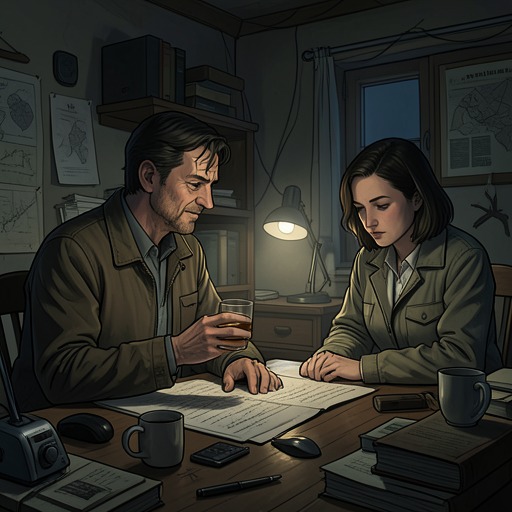
The cost of his commitment appears in a later decision whose details Eli opposes. Hakan Bengtsson has burned palms and wants to comfort her, but cannot caress her. He crouches beside her as they discuss what he plans to do that night. Concerned that people who saw a newspaper picture may know where he lives, Eli warns him of the danger. He takes her hand, retrieves an old jam jar containing clear liquid, and explains his plan; she objects vehemently. Hakan Bengtsson insists that he can do it and makes his willingness to proceed a declaration of how much he cares. The evidence establishes that he is prepared to take a serious risk for Eli, while Eli’s objection matters too: receiving care does not mean consenting to every sacrifice made in her name.
Protection and care in ordinary gestures
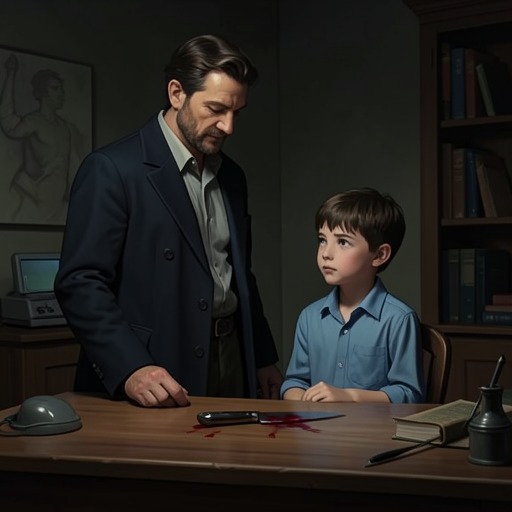
Sacrifice is not confined to life-threatening choices. After a boy of Oskar’s age is murdered, Oskar’s mother reaches across the kitchen table, squeezes his hand, and warns him not to go into the woods alone. Tears in her eyes register her distress, while the prohibition gives that distress a practical form: she tries to protect her son by limiting his freedom. The scene places intimate family care against the larger fear created by the murder. Unlike Hakan Bengtsson’s grand language about offering one’s life, her care takes the shape of touch, attention, and a specific warning. It is a small intervention, but its purpose is unmistakably to keep Oskar safe.
The contrast helps broaden the concept beyond heroic sacrifice. Hakan Bengtsson’s devotion is bound to an extraordinary threat and to Eli’s dependence on him; Oskar’s mother acts within the familiar responsibilities of parenthood. In both cases, love produces an effort to preserve another person, but the form and stakes differ. Her warning also shows that protection can involve directing another person’s choices. The scene supports neither a simple condemnation nor an uncomplicated celebration of that control: it records a mother responding to danger with the means immediately available to her.
Lacke and Virginia: presence without an answer
Lacke’s care for Virginia takes the form of staying with her and imagining a future they might share. Holding her hand, he tells her about the stamps, the lion, Norway, the money, and the little cottage they could buy. He pictures its red Falu paint and describes flowers and a shaded place where they could sit. Virginia begins to cry silently as he speaks; the scene leaves open whether the tears carry sadness, joy, or both. The future Lacke describes is not a completed plan. It is an offer of companionship, made while Virginia is vulnerable and the future remains uncertain.
When Lacke obtains an extra cot and places it directly beside Virginia’s, his imagined future gives way to an immediate act of closeness. He turns out the light, gets into the stiff sheets, and finds her hand. Virginia tells him she loves him. Lacke does not answer aloud; he lets her words remain between them, and the narration figures them as a red blanket that settles over him and keeps him warm through the night. This ending complicates the expectation that sacrifice must be publicly announced or returned in kind. Lacke’s response is to stay beside Virginia and receive what she has said, not to make a matching declaration.
The limits and meanings of giving
Across these relationships, self-sacrifice is neither a single act nor an uncomplicated moral measure. Hakan Bengtsson’s conduct is shaped by a belief that love requires giving oneself, yet he also wants affection that is not merely payment for keeping Eli alive. Eli acknowledges that dependence directly and resists a dangerous plan, preserving her own judgment within a relationship in which she needs his help. Oskar’s mother protects through an immediate restriction, while Lacke offers imagined plans and bodily presence without demanding an answer. Together, the scenes make care visible in different scales: money carried in hope of rescue, a hand squeezed across a table, a risky plan offered as proof of devotion, and a cot placed beside a loved one’s bed. The ideal remains powerful, but the novel tests it against the actual person receiving care, the giver’s mixed motives, and the difference between offering oneself and deciding for someone else.